
1° Definition
Distorting power is a component of apparent power that emerges when voltage or current waveforms deviate from the perfect sinusoid, i.e. in the presence of " harmonics ".
Harmonic distortion is generated by so-called non-linear loads connected to the distribution network.
This phenomenon manifests itself by the absorption of non-sinusoidal currents rich in harmonics which will in turn produce harmonic voltages at the different connection points.
Physically, distorting power represents energy oscillating between source and load without being converted into useful work or stored reactively.
2° Non-linear load
A load is classified as non-linear when the current it absorbs does not have the same shape as the voltage supplying it.
This current contains several harmonic components whose spectrum will depend on the nature of the load.
These loads generate harmonic currents that flow from the load to the source along the path of least impedance.
These harmonics are integer multiples of the fundamental frequency and often result from nonlinear loads such as:
variable speed drives,
static converters,
switching power supplies,
certain types of lighting.

3° Definition and origin of harmonics
4° Classification of harmonics
Harmonics are classified according to their rank:
Odd harmonics : 3rd (150 Hz), 5th (250 Hz), 7th (350 Hz), etc.
Even harmonics : 2nd (100 Hz), 4th (200 Hz), 6th (300 Hz), etc.
In three-phase systems, harmonics of multiple order of 3 (3rd, 6th, 9th, etc.) are called: “ zero sequence harmonics ”.
They add up in the neutral conductor, which can cause it to be overloaded.
5° Effects of harmonics on electrical systems
The presence of harmonics can have several harmful consequences:
Equipment overheating: Harmonic currents cause additional heating in transformers, motors and cables, reducing their lifespan.
Voltage distortion: Harmonic currents flowing in the network impedances create harmonic voltage drops, distorting the supply voltage.
Power factor reduction: Harmonics increase apparent power without contributing to active power, thus decreasing the power factor and resulting in financial penalties.
Equipment Malfunctions: Harmonics can cause nuisance tripping of circuit breakers, measurement errors and disruptions in communication systems.
6° Harmonic distortion rate
All these harmonics can be added together, the resultant forms the " THD " : " the harmonic distortion rate ".
Observed in the form of harmonic distortion, one of the solutions intended to detect the presence of harmonics and the calculation of THD, there are two types:
current distortion (due to loads),
voltage distortion (appears at the source).
This harmonic distortion rate corresponds to the ratio between the real effective value of the harmonic of a signal (U or I) and its effective value at the frequency of the fundamental.
To know the overall deformation of voltage and current signals, it is necessary to take into account all the harmonics present.
The following expression allows us to define the overall value of the THD:

7° Decomposition into Fourier series and harmonics
Any periodic signal can be represented as a sum of sinusoids at different frequencies, by the Fourier series:
i(t)=I1 sin(ωt + ϕ1) + I3 sin(3ωt + ϕ3) + I5 sin(5ωt + ϕ5)+…
I1: fundamental component (frequency f)
I3,I5,…: harmonic components (3rd, 5th, etc.)
These harmonic components are integer multiples of the fundamental frequency f, and represent the distortion of the signal.
8° Mathematical definition
We assume that voltage and current are periodic but not sinusoidal → they are written in Fourier series:
Harmonic decomposition:
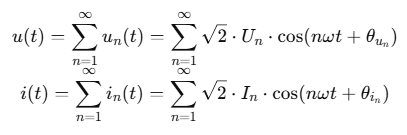
n = 1→ fundamental
n > 1→ harmonics
Un and In → effective values of each harmonic
θun and θin→ phases of each harmonic
9° Powers in non-sinusoidal regime
Total active power
This is the average energy transmitted per second, sum of the active powers of each harmonic:

Total reactive power
We can no longer say Q=U⋅I⋅sin(φ) on the global signal, we must also calculate it harmonic by harmonic:

Total apparent power
This is the product of the total effective values:

10° The distorting power
In alternating mode, the apparent power (S) is composed of three orthogonal elements:
Active power (P): energy actually consumed (in watts, W)
Reactive power (Q): energy exchanged between the electric and magnetic fields (in volt-amperes reactive, VAR)
Distorting power (D): energy linked to harmonic distortions (in distorting volt-amperes, VAD)
The relationship between these powers is given by:

In non-sinusoidal conditions, voltages and currents may contain harmonics.
Unlike the pure sinusoidal regime where the reactive power Q is sufficient to express the phase shift effects, in non-sinusoidal regime, the waveform distortion effects must also be considered.
Or :
Q is the reactive power (related to the fundamental phase shift)
D is the distortion power (related to harmonics)
And often, QD denotes non-active power, that is:

This includes:
reactive power Q
the distortion power D
It is an aggregate measure of what does not contribute useful work, but is still present in the system (for example, overloading cables or transformers).
10° Complete example
Common data
Effective voltage: U = 230 V
Effective current: I = 5 A
Fundamental frequency: f = 50 Hz
Period: T = 20 ms
Cosine phi (fundamental): cosφ1 =0.95 ⇒ φ1 = 18.2∘
Sinusoidal Regime
a) Temporal expressions
%20d%C3%A9form%C3%A9.png)
b) Powers (with integral definition):

Non-sinusoidal regime
Assumption :
Voltage always sinusoidal at 50 Hz,
Non-sinusoidal current with harmonic components (3rd and 5th),
Same total effective current: Ieff = 5 A
a) Spectral decomposition of i(t)

b) Hypothesis:
Realistic harmonic distribution of a typical power electronics case:
3rd harmonic: 70% of the distortion
5th harmonic: 30%

C) Power calculations

d) Distortion rate

e) Real power factor (total PF)
The overall power factor in a non-sinusoidal regime is broken down into two parts:
cosφ = 0.95
I1 = 4.21 A
Ieff = 5 A

d) Distortion rate
Conclusions
Same effective current → same apparent power,
But reduced active power in non-sinusoidal mode,
Appearance of distorting power (D) due to harmonics: source of losses,
This degrades the power factor, causes additional losses and reduces efficiency.
The power factor drops from 0.95 to 0.80, solely due to harmonics.
This means that 20% of the energy supplied is not used to produce useful work (P), but is lost as reactant or distortion.

Triangle of Powers
P: Active Power (W)
Q: Reactive power (VAR)
S: Apparent power (VA)
D: Distorting power (VAD)
Sh: Distorted apparent power